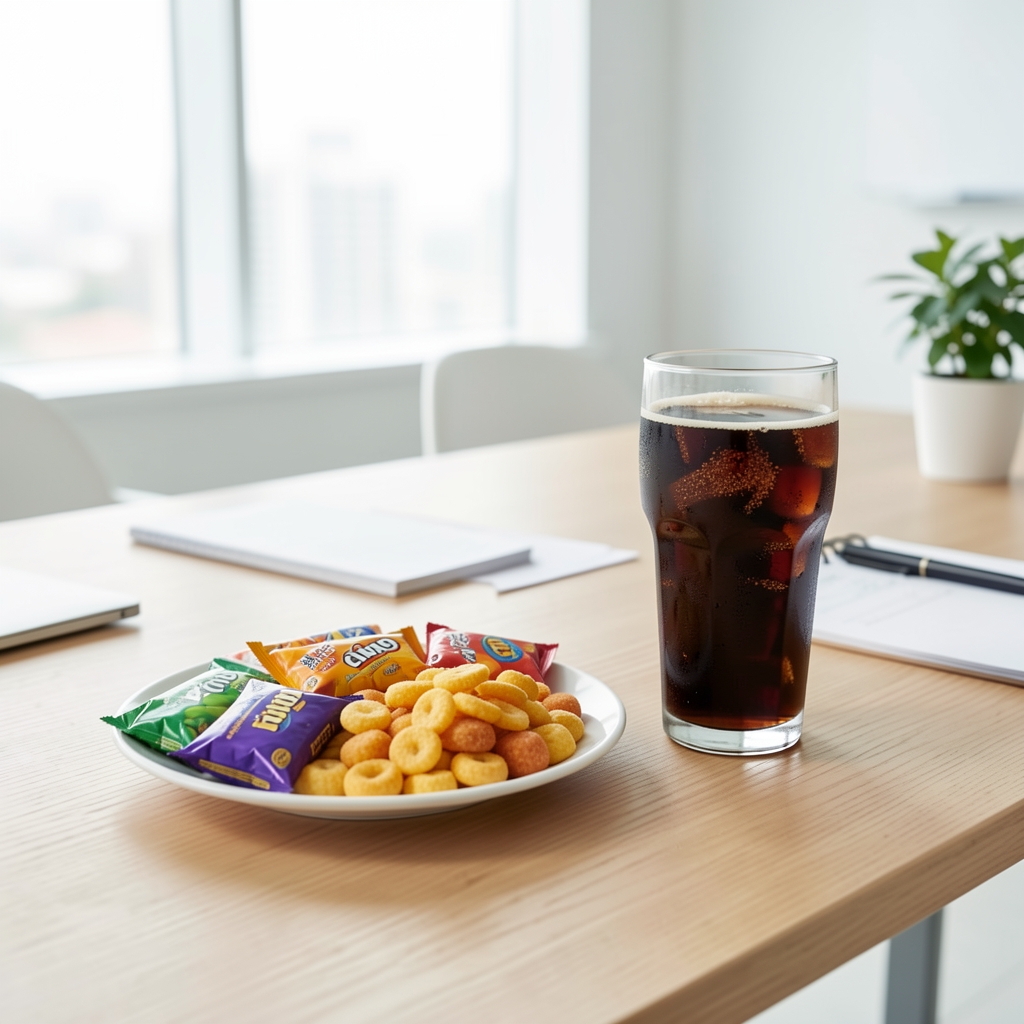
The morning coffee with two sugars, the glass of orange juice at breakfast, the sports drink consumed during a lunchtime walk, the soft drink ordered with an evening meal — these are not, in most people's internal accounting, things that constitute eating. They are drinks. They are background. And that categorical distinction — solid food is food, liquid is not — is one of the more consequential oversights in everyday nutritional awareness.
Why drinks escape the food ledger
Liquid calories awareness is a relatively recent area of nutritional focus, and the research consistently surfaces the same finding: people are poor at tracking the energy content of what they drink, even when they are actively attempting to monitor their food intake. This is not simply a knowledge gap. Studies using food diaries that include beverages show that even nutritionally informed participants systematically underreport drink-derived calories relative to their food-derived counterparts.
Part of the reason is satiety: drinks, including sweetened ones, produce weaker fullness signals than equivalent calories delivered in solid form. A 300-calorie sweetened drink does not replace the appetite that 300 calories of food would. The drink is metabolised, but the appetite it should have addressed remains largely intact — and the next meal is eaten at full capacity. This is the mechanism through which liquid calories accumulate beyond the threshold of normal attention.
Hidden sugars in everyday food compound the issue when beverages are consumed alongside processed foods — as they usually are. A ready meal with a soft drink delivers a sugar load from both sources, and the consumer's mental accounting attributes the excess only to the food. The drink is invisible in the ledger.
"A 300-calorie sweetened drink does not replace the appetite it should address. The drink is metabolised — but the appetite remains intact."
The specific categories to examine
Not all liquid calories behave identically in the food ledger. Some categories are more consistently overlooked than others, and it is worth mapping them specifically rather than regarding all beverages as equivalent.
Fruit juices and smoothies occupy a curious position. They are widely understood as healthy choices — and the vitamins and fibre they contain justify a degree of nutritional credit. But their sugar concentration is substantial, and the absence of whole-fruit fibre means the sugar is absorbed quickly. A 330ml glass of orange juice contains the equivalent sugar of approximately three whole oranges — a quantity that would be consumed far more slowly and with significantly more satiety in its original form.
Coffee-shop drinks — the large lattes, flavoured frappes, and sweetened teas available from high-street chains — represent a caloric category that has grown significantly over the past two decades. A large flavoured latte with full-fat milk and two pumps of syrup can contain 400-500 calories, a figure that rivals a full meal. Yet it is purchased alongside a meal, consumed in the context of a meeting or commute, and rarely registered as a food intake event.
Sports and energy drinks extend this issue into the active-lifestyle context. Their association with physical exertion — whether or not the consumer is engaged in the kind of exercise that would justify the caloric content — positions them as neutral or even beneficial. The sugar and refined carbohydrates they contain map directly onto the refined carbohydrates and weight literature: rapid absorption, limited satiety, and a contribution to the daily caloric total that is structurally invisible.

Mindless snacking and its liquid equivalent
Mindless snacking is a well-documented phenomenon: the consumption of food in the absence of hunger, driven by cue-reactive behaviour — seeing food, being near food, feeling bored or stressed. The liquid equivalent operates through parallel mechanisms but attracts considerably less attention in the literature on eating patterns.
The perpetually-open soft drink on a desk, the tea or coffee made at each transition between tasks, the glass of juice consumed while preparing a meal — these are the liquid correlates of mindless snacking. They share the key features: low awareness of quantity consumed, cue-reactive rather than hunger-reactive initiation, and a cumulative caloric contribution that reveals itself only in aggregate.
The distinction between drinking out of habit and drinking out of thirst mirrors the distinction between eating out of habit and eating out of hunger. In both cases, the relevant question — am I actually hungry or thirsty, or am I responding to a contextual cue? — is rarely asked, because the eating or drinking behaviour has become sufficiently automatic that no conscious decision appears to have taken place at all.
What awareness actually changes
The practical implication of liquid calories awareness is not simply that people should stop drinking flavoured beverages. The more useful observation is structural: the category of "drinks" needs to be incorporated into whatever framework someone uses for understanding their eating patterns. This is not an argument for compulsive calorie counting — the evidence for that approach is mixed and the psychological costs are non-trivial. It is an argument for category awareness: recognising that certain beverages carry caloric weight, and that this weight accumulates.
Gradual dietary improvement in this domain looks like a few specific substitutions made without fanfare: water replacing a daily soft drink, an unsweetened coffee replacing a flavoured one, a piece of fruit replacing a juice. These are not dramatic changes. They are the kind of adjustments that, applied consistently, shift the weekly food rhythm in a direction that the aggregate caloric data supports — without requiring the wholesale restructuring that most eating programmes demand and most people decline to sustain.
The central observation — that drinks sit outside most people's mental model of food — is not primarily a nutritional fact. It is a psychological one. And it is worth attending to precisely because its effects are real, cumulative, and almost entirely avoidable once they are brought into view.
- ■ Liquid calories are systematically underreported even by nutritionally attentive people, because drinks are categorised outside the food ledger.
- ■ Sweetened drinks produce weaker satiety signals than equivalent solid-food calories — the appetite they should address largely persists.
- ■ Fruit juices and large coffee-shop drinks carry caloric loads that rival meal equivalents, but are rarely recognised as such.
- ■ Gradual dietary improvement in this area comes from category awareness and a small number of consistent substitutions, not wholesale restriction.